Training by role

    AI training for executive assistants and administration

    With Maijin, train your administrative teams across French-speaking Switzerland to save time on drafting, formatting and document follow-up, without losing any rigour or confidentiality

    • More than 150 organisations supported across French-speaking Switzerland and France
    • 4,500 professionals trained since January 2023
    • 5.0/5 on Google (51 reviews)
    • Maximum of 12 participants per session, at your offices or remotely
    • Training delivered in French and English, German available
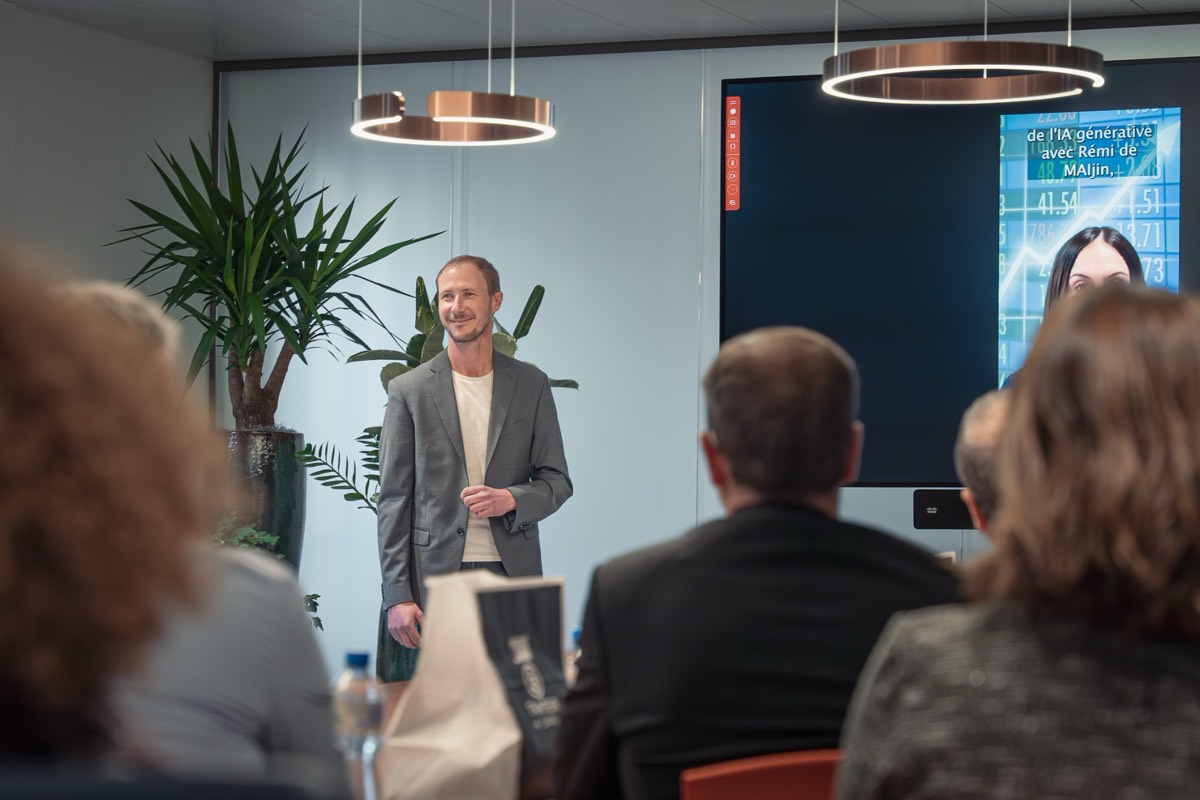
    Maijin trainer leading a generative AI training session for a group in a meeting room
    12participants max per session

    Writing a letter, formatting a set of minutes, comparing three supplier quotes, finding the right internal procedure: these tasks are essential, rarely rewarding, and they take up a disproportionate share of your administrative teams' time, whether they work as executive assistants, in a secretariat or in the back office. That is where AI training for administration changes something: embedding generative artificial intelligence into the day-to-day processes of administrative roles, on the documents your teams already handle.

    Most administrative staff have already tried ChatGPT for an email or a summary. Few have a framework: which documents can you actually upload to a consumer AI tool when you handle data about employees, beneficiaries or citizens? How do you get a result that looks like your in-house templates rather than generic text?

    Our benchmark, observed in the field: two hours freed up per week for 80% of office employees, provided you move from individual ChatGPT use to a shared method and shared templates.

    The cost of waiting

    AI training for administrative teams: what it really costs

    Without a framework or shared templates, your administrative teams reinvent the wheel with every document, every email and every set of minutes:

    The document maze

    Procedures, internal notes and minutes pile up in different formats, never summarised or updated. Finding the right version takes longer than reading it.

    The email backlog

    Every standard reply is rewritten by hand, in a tone that varies from one colleague to the next. The approval chain and internal references (file number, cross-references) are often forgotten or badly worded.

    Minutes and schedules

    Writing up a meeting easily takes an hour after the fact, when it gets written at all. Decisions, tasks and deadlines get lost in handwritten notes nobody ever revisits.

    Procedures nobody can find

    The internal rules, the IT charter and the HR guide all exist, but nobody knows where to look for the right answer. New joiners ask the same question ten times to the same people.

    Document checking

    Comparing an incoming contract against your standard template, checking that a form is complete, cross-referencing several supplier quotes on the same criteria: all manual, repetitive checks, and easy to get wrong.

    Meanwhile, administrative teams trained with a method save several hours a week on those same tasks, without sacrificing proofreading or compliance.

    Since January 2023

    AI training for administrative teams: numbers, not promises

    • More than 150 organisations trained across French-speaking Switzerland and France
    • 4,500 professionals trained since January 2023
    • 5.0/5 from 51 Google reviews
    • Sessions delivered in French, English and German
    Jean-Baptiste BerthouxRémi VancayzeeleLaurent Rajca
    Trainers who use AI every day on their own projects, not only in the training room.
    5.0 out of 51 Google reviews
    Train your teams

    AI use cases in administrative roles

    These are the tasks our participants automate most often, in a Swiss SME, association or public administration. Each one is worked through on your own documents during the training, never on a generic example.

    Drafting
    • Standard letters and emails: a reply to a recurring request, a reminder, a convocation, a reasoned refusal, in your organisation's tone
    • Minutes and meeting reports: decisions, tasks, owners, deadlines, points to watch
    • Codified official documents: employment certificates, attestations, internal notes, with the mandatory wording used in French-speaking Switzerland
    • Internal translation between French, German and English: letters, service notes, HR documents, with human review before circulation
    • Rewriting in plain language and in easy-read format for non-specialist audiences
    Organising
    • Diary management and prioritisation: arbitrating between competing requests, preparing a week, protecting blocks of focused time
    • Agendas and meeting preparation: a timed agenda, the list of documents to prepare, the questions to settle
    • File preparation: gathering, ordering and summarising the documents in a file before it is passed on
    • Multi-team back-planning: milestones, dependencies, owners, checkpoints
    • Checklists and deadline tracking: turning a procedure into a reusable checklist
    Processing
    • Sorting and summarising long documents: a report, a procedure or a set of regulations reduced to a usable note
    • Swiss administrative forms: understanding what is being asked, preparing the documents, checking a file is complete before sending it
    • Compliance checking: comparing an incoming document (contract, purchase order, official letter) against your standard template and listing the differences
    • Comparing supplier quotes against identical criteria: price, lead times, guarantees, penalties
    • Cleaning up data exports (contacts, suppliers, inventories): duplicates, empty fields, inconsistencies
    Structuring
    • Filing and naming: defining a naming convention and applying it to an existing document collection
    • Internal reference material: turning a set of regulations, an IT charter or an HR guide into an internal FAQ
    • A glossary of acronyms and a "who does what, who to ask" document
    • A library of approved templates: letters, emails, meeting minutes, with standard subject lines and legal mentions
    • An AI usage charter: what may be entered into which tool, who reviews what, what never leaves the organisation
    In-company AI training for Administrative with Maijin
    Our method

    AI training for Administrative in Switzerland: we come to where your teams are

    Training built on your real files, not on generic examples

    Before each session we ask you for three or four genuine pain points: a file that keeps slipping, a document nobody has time to write, a manual step everyone copies from the last person. The exercises are built on those, never on a textbook case.

    From the first hour we also set a clear rule about what may go through an AI tool and what must never leave your organisation. Your teams walk away with the habit, not just with the demo.

    Our approach

    We train administrative professionals to put generative AI to work

    We do not train people in "AI in general". We train executive assistants, secretariat and back-office teams, in the private sector as well as in public administration, on their real documents and their real use cases.

    Our approach:

    Step {n} 01

    1. Sector expertise in administration

    We do not start from a generic training course. We work on your real documents: your letter templates, your minutes, your internal procedures, whether you are an SME, an association or a public administration.

    Step {n} 02

    2. Confidentiality and a framework for use

    Administrative data often involves personal information (employees, beneficiaries, citizens). We systematically train people in good practice: anonymisation, secure enterprise versions, compliance with the revised Swiss Data Protection Act (nLPD), and the drafting of an internal usage charter.

    Step {n} 03

    3. Support in spaced half-day sessions

    Half-day sessions spaced 1 to 3 weeks apart, in groups of no more than 12 to keep the sessions interactive. Before each session, a scoping questionnaire and an installation sheet go out to participants: no live installation on the day. Between sessions, short exercises on your real documents keep the attention going. We adjust the templates, correct the prompts and embed the habits over time rather than compressing everything into a single day.

    The result of AI training for administration built on your own documents: your administrative teams save time on drafting and formatting, and keep full control over proofreading, compliance and confidentiality. As with all our engagements, the follow-up does not stop at the last session. A former participant in an inter-company course, since appointed HR director of a financial group, sums up what the training left her with: she uses ChatGPT every week and describes it as a genuine tool of professional and personal emancipation.

    We have notably worked with the board of the Fondation Aigues Vertes, a Geneva foundation in the financial sector and OCAS Geneva (the cantonal social insurance office) on the use of generative AI in their administrative work.

    Our AI administration training formats

    Three ways in, depending on your team's starting level and the time you can free up for them.

    Discovery training

    A first session to give the whole team the same foundation: what these tools can do, what they cannot, and the first few moves that save time from the next morning on.
    Recommended

    Spaced half-day support programme

    The complete path, from the foundation through to the most advanced uses in your field, delivered as half-day sessions spaced 1 to 3 weeks apart. A rhythm designed for busy managers: in between, your teams work through exercises on their real files, and we adjust the next session around whatever got stuck.

    Highly specific workshop

    One short slot, one tool, one precise task. The format to pick when the foundation is already there and a single use case still needs unlocking.

    Example

    Copilot to turn a Teams recording into usable minutes, as an executive assistant

    90-minute workshop: CHF 1,000. Half day: CHF 2,000. Full day: CHF 3,000 to 3,500. Day of targeted workshops: CHF 2,500. Rates exclude VAT, apply per group session of up to 12 participants, and include travel costs. The spaced half-day programme is quoted on the half-day rate (CHF 2,000 per session).

    Our track record in artificial intelligence training in Switzerland

    2 h → 5 min

    pour synthétiser un document long en une version exploitable

    20 min → 3-4 min

    pour la rédaction des e-mails et rapports d'un coach emploi

    45 min

    gagnées sur la rédaction d'un procès-verbal de réunion de 2 pages, pour une fondation genevoise du secteur financier

    +150

    organisations accompagnées par Maijin depuis 2023

    Scoping call, no commitment

    Let us find the AI administration training format that fits your team

    30 minutes to scope your need, quote within 48 hours.

    Discuss your projectNo commitment, and the scoping call is not charged.

    Études de cas : l'IA dans des services administratifs suisses

    Cas 1 : haute école romande, service administratif

    Contexte

    Service administratif d'une haute école romande, 30 collaborateurs formés à l'IA générative. Les besoins ont été recueillis par formulaire en amont, les cas d'usage de l'atelier validés par le chef de service, et une banque de prompts propre au service remise aux équipes, utilisable dès la fin de la formation.

    Cas 2 : Fondation Aigues Vertes

    Contexte

    Fondation genevoise du secteur socio-éducatif, qui accompagne des personnes en situation de handicap. Le conseil d'administration et la direction ont été formés sur 4 demi-journées, réparties en 2 groupes de 12, avec un cas d'usage construit avec eux : l'assistant du veilleur de nuit. Résultats : 98,5 % de satisfaction globale et un Net Promoter Score de +70,6, sur 17 répondants.

    Cas 3 : OCAS Genève

    Contexte

    Office cantonal des assurances sociales de Genève, organisation publique en contact quotidien avec un large public d'administrés.

    Défi

    Faire monter en compétence les équipes administratives sur l'IA générative, dans un cadre où la confidentialité des données des administrés est non négociable.

    Résultats
    • La direction a pris conscience d'un changement de fond dans la façon dont les administrés cherchent l'information : de plus en plus via un assistant conversationnel plutôt que par une recherche classique sur le site internet de l'office
    Impact

    Cette prise de conscience a ouvert un chantier au-delà de la formation : structurer le contenu du site pour qu'il soit correctement compris et cité par les IA génératives (GEO), en complément du travail sur les usages internes.

    Cas 4 : association faîtière romande du secteur social

    Contexte

    Association faîtière regroupant une trentaine d'institutions actives dans le handicap, la précarité, l'enfance et l'enseignement spécialisé, secrétariat général basé en Suisse romande. Organisation anonymisée, hors de la liste des clients nommables.

    Défi

    Professionnaliser un usage de l'IA déjà quotidien mais individuel, sans charte ni gabarits partagés, sur des livrables à forte exposition (prises de position publiques, presse, autorités).

    Programme
    • Rédaction et structuration documentaire : courriers officiels, notes stratégiques, procès-verbaux, check-lists de conformité
    • Analyse et chiffrage : modèles budgétaires, tableaux comparatifs
    • Mise en place de garde-fous : charte d'usage, bibliothèque de gabarits validés, processus de relecture croisée
    Résultats
    • Gain de temps observé sur la première version des documents courants (courriers, notes, comptes rendus)
    • Gain de temps sur la mise en forme, les synthèses et les relectures ciblées
    • Gain plus mesuré, mais qualité initiale plus élevée, sur les livrables à haute exposition (moins d'itérations nécessaires)
    Impact

    Le secrétariat général dispose désormais d'un cadre d'usage partagé (charte, gabarits, double relecture) plutôt que d'usages individuels dispersés, avec un contrôle humain systématique avant toute diffusion externe.

    Autres références administratif et back-office

    FOVAHM (Fondation en faveur des personnes handicapées mentales), Valais : découverte que l'IA est compétente en FALC (facile à lire et à comprendre), avec des économies sur des coûts de logiciels FALC autrement très élevés
    Institutions sociales romandes (fondations et associations) : structuration documentaire et rédaction officielle pour les fonctions support
    Organe de contrôle financier cantonal : automatisation des macros et rédaction des rapports d'audit (voir aussi notre parcours Finance)

    AI administration training near you: Geneva, Vaud, Valais, Neuchâtel, Fribourg

    We travel to your premises across French-speaking Switzerland. Each canton page details the formats, the prices and the companies we have trained there.

    Your AI trainers for Administrative

    Jean-Baptiste Berthoux

    Jean-Baptiste Berthoux

    Chief AI Officer

    An engineer by training, Jean-Baptiste gave his first AI coaching in January 2023. Drawing on his experience, he developed a unique pedagogy, the fruit of his field work and his mastery of the tools.

    LinkedIn
    Rémi Vancayzeele

    Rémi Vancayzeele

    CEO

    Serial entrepreneur, Rémi has 15 years of experience in managing complex projects. In 13 months, he trained more than 1,300 people and built the pool of trainers and consultants at MAIjin.

    LinkedIn

    FAQ: AI training for Administrative in Switzerland

    Yes, and there are no technical prerequisites. MAIjin's AI training for administrative roles is designed for non-technical profiles: executive assistants, secretariat and back office, in the private sector as well as in the Swiss public sector. The discovery training starts from zero and works on your real documents, not on abstract exercises. People who describe themselves as hopeless with computers are among our regular participants. Groups are capped at 12 participants and everyone works on their own letters, their own minutes and their own procedures, which lets us set the pace by the room's actual level rather than by a theoretical syllabus.

    AI training for administrative roles necessarily involves data about employees, citizens or beneficiaries. MAIjin systematically trains people on the secure enterprise versions of the tools, on good anonymisation practice, and on classifying what may and may not be entered into a consumer tool. We only train on professional versions with a data processing agreement, no retention and no training on your content, never on free versions: that is what allowed a Geneva foundation in the financial sector to turn a Teams meeting recording into minutes without using free tools that would have moved sensitive data out of Switzerland. For the Swiss public sector and social institutions, compliance with the Swiss Data Protection Act and the revised FADP is built into the first module, together with the drafting of a usage charter specific to your organisation. That charter and the classification stay with you after the training: they are what protects you day to day.

    By keeping the review on the human side, every time. AI prepares a good first draft; checking the figures, verifying the mandatory wording and the final decision stay yours. We train three reflexes for that. Supply the material as input, your standard template, the applicable regulations or the recording of the meeting, rather than letting the tool reconstruct content from memory, which is exactly when it starts inventing. Require it to flag what it cannot find instead of filling the gap, particularly a date, an amount or a file reference. And put in place a cross-review before any external circulation, like the one adopted by the general secretariat of a French-speaking Swiss umbrella association in the social sector for its public position papers. On those highly exposed documents the time saving is more modest than on a routine email, but the quality of the first version is higher and fewer iterations are needed.

    Yes, and they make up a significant share of our clients. We have worked with OCAS Geneva, the Fondation Aigues Vertes and umbrella associations in the social sector. Confidentiality constraints and the more formal register of official letters and public position papers are built into the training, as are the codified documents specific to the Swiss context: employment certificates, attestations and administrative forms with the mandatory wording used in French-speaking Switzerland. Compliance with the Swiss Data Protection Act and the revised FADP is part of the first module whenever you handle data about citizens or beneficiaries. At OCAS Geneva, the training also brought a deeper shift to light: citizens increasingly look for information through a conversational assistant rather than on the office website, which opened up a project beyond the training itself.

    Yes, the training uses your real environment. Mainly ChatGPT and Claude for writing and analysis, Copilot for the Outlook and Excel integration, and NotebookLM to query your own documents and procedures. The choice depends on your confidentiality constraints and on the tools you already have: an organisation already running Microsoft 365 has good reason to start with Copilot, for reasons of rollout cost more than performance. The programme is built during the exploration session around your tools and your templates, not around an imposed stack.

    MAIjin charges CHF 3,000 to 3,500 for a full day of AI training for administrative roles, and CHF 2,000 for a half day, excluding VAT, travel costs included, per group session of up to 12 participants. A targeted 90-minute workshop at CHF 1,000 allows an initial scoping, and a day of targeted workshops in 90-minute slots costs CHF 2,500. The spaced half-day programme is quoted on the half-day rate (CHF 2,000 per session). The price does not depend on how many people are in the room, up to 12, and the preparatory 30 to 45-minute scoping call is not charged. Training takes place at your premises, anywhere in French-speaking Switzerland.

    Three common formats. The discovery training, to give the whole team a shared foundation and the first use cases that actually run on your own documents. The spaced half-day programme, half-days 1 to 3 weeks apart, our recommended format, which goes from the foundation through to templates and internal reference material, with exercises on your real files between sessions. And the highly specific workshop of 90 minutes, one tool for one task: Copilot to turn a Teams recording into usable minutes, as an executive assistant, a workflow that saved a Geneva foundation in the financial sector 45 minutes of writing per two-page set of minutes. The right format is settled in a 30 to 45-minute scoping call, at no charge.

    MAIjin delivers its AI training for administrative roles in French and English. German is available subject to trainer availability and is agreed during the exploration session. Whatever the language of delivery, the training covers internal translation of your letters and administrative documents between French, German and English, a common need in Swiss organisations that work with German-speaking counterparts.

    Yes. Between the sessions of a programme, your teams practise on their real files and come back with what got stuck: we adjust the templates and correct the prompts. As with all our engagements, the follow-up does not stop at the last session. The deliverables stay with you and they are what makes the practice last: a library of approved templates, a prompt bank tailored to your tasks like the one built for the administrative department of a university in French-speaking Switzerland, and an internal usage charter. Organisations that want the practices to hold move on to days of targeted workshops in 90-minute slots. It is the round table at the following session that turns a demonstration into a habit, not the first day.

    We do not deliver an academic curriculum: we install working practices. General AI training shows you tools. AI training for administrative roles starts from your tasks: your letter templates, your minutes, your internal procedures, your forms. At MAIjin the difference shows in the deliverable: participants leave with templates and a prompt bank built on their own documents, not with notes taken on fictional examples. Add to that 12 participants maximum, trainers who use AI every day on their own assignments, and a programme built on the cases raised during scoping. That is what explains the 5.0/5 rating from 51 Google reviews and the documented results of our case studies, from the Fondation Aigues Vertes to OCAS Geneva.

    Drafting and formatting tasks pay off first: email replies, meeting minutes, summaries of long documents, letter templates, comparison tables for quotes. AI prepares a good first draft; proofreading, checking the figures and the final decision stay human.

    Our benchmark: two hours a week for most office employees, as soon as a framework and shared templates replace individual use. On specific tasks the measured gaps are wider: summarising a document goes from 2 hours to 5 minutes, writing the emails and reports of an employment coach from 20 minutes to 3-4 minutes, and a two-page set of meeting minutes saves 45 minutes of writing.

    MAIjin limits its AI training for administrative roles to 12 participants per group, so that everyone works on their own documents during the session. Beyond that we form several groups: the Fondation Aigues Vertes, for example, was trained in 2 groups of 12 over 4 half-days, and the administrative department of a university in French-speaking Switzerland trained 30 staff this way.

    MAIjin's AI training courses for administrative roles take place at your premises, in Geneva, in canton Vaud, in Valais, in Neuchâtel and in Fribourg. Travel costs are included in the rate. MAIjin Sàrl is based in Geneva, at rue de Lyon 109.

    Two weeks before each session, MAIjin sends participants a scoping questionnaire and a setup sheet, so that not a minute of the training is spent installing software. The use cases worked through in the workshop are collected from the teams and then arbitrated by their manager, as at the administrative department of a university in French-speaking Switzerland, where the needs of 30 staff were gathered through a form and the cases approved by the head of department.
    Tailored quote

    Train your teams in AI

    Jean-Baptiste BerthouxRémi Vancayzeele

    Get in touch with Jean-Baptiste and Rémi, they will be glad to answer your questions

    • A 30 to 45-minute scoping call, at no charge
    • A programme built around your three priority pain points
    • Your confidentiality constraints settled before the first session

    Your details are used only to handle this request. They are never sold or used for anything else.

    or book a 30-minute call straight away
    L'hebdo mAIjin