Training by role

    AI training for managers and executive committees

    With Maijin, train your managers to delegate, decide and lead their teams with AI, without ever handing it the final call

    • More than 150 organisations supported, from the executive committee to front-line teams
    • 4,500 professionals trained across French-speaking Switzerland and France since January 2023
    • 5.0/5 on Google (51 reviews)
    • Maximum of 12 participants per room, travel costs included
    • Training delivered in French and English, German available
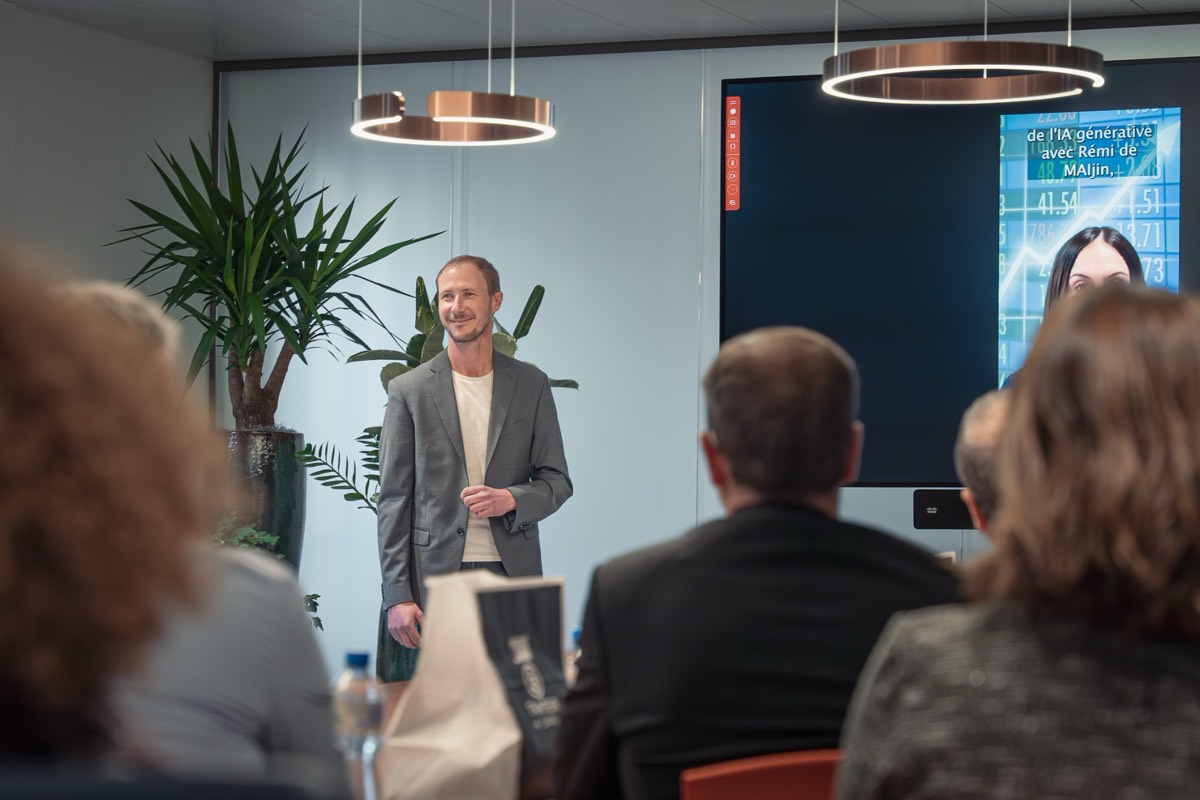
    Jean-Baptiste Berthoux in a Maijin training room, laptop open and slides projected in the background
    12participants max per session

    A manager permanently walks a line: close enough to the ground to understand what their teams live through, high enough to hold the course set by the leadership. While the company tries generative artificial intelligence on marketing, finance or HR, the link that holds the rest together is often left unequipped: middle management. Our AI management training starts from that link: managers new to generative AI who then embed it into their day-to-day steering, arbitration and delegation.

    Managers also know what happens when delegation is poorly framed: the work comes back off target, not because the person lacked the skills, but because the brief was never written down clearly. A meeting without an agenda goes round in circles. A decision made under pressure, without comparing scenarios, becomes hard to explain afterwards to the team that has to live with it.

    At Maijin, we train your managers to use AI as a co-pilot for steering: it prepares, structures and challenges the options, but the decision and the trade-off stay entirely human.

    The cost of waiting

    AI management training: what jams day-to-day steering

    Without a method for bringing AI into their management practice, your managers lose time and clarity on exactly the situations AI could help untangle:

    Delegation that boomerangs back

    The manager thinks they were clear. The colleague understood something else. The deliverable arrives, it is off target, everything has to be redone. It is almost never a skills problem: it is a brief that was never written down (objective, deadline, level of quality, context).

    Meetings that go nowhere

    An agenda rushed or improvised at the last minute, a meeting that drags on with no clear decision at the end, minutes that never arrive or that nobody reads. The team's collective time goes up in smoke.

    Decisions made without comparing scenarios

    With no time to work through the "what ifs", the manager settles on the first option available. Blind spots only surface afterwards, and the team struggles to follow the logic of the trade-off.

    Poorly prepared arrivals

    A dated welcome pack, a vague integration schedule, an overloaded manager with no time to explain everything. The new joiner fends for themselves in the first few weeks, and becoming autonomous takes twice as long as it should.

    Adoption left to chance

    In our audits, 68 to 79% of employees already use AI informally, sometimes on free consumer accounts and with sensitive data, without a single rule having been set. Managers also have to handle a generational paradox: getting managers over 40 who have never tried it off the ground, while framing the already intensive but unsupervised use of younger colleagues. They carry both a security risk and untapped time savings.

    Meanwhile, managers who set a clear framework early save time on steering, cut down delegation misunderstandings, and bring their teams along without exposing sensitive data. Our benchmark, deliberately measured rather than inflated: two hours saved per week, for 80% of office employees, managers included.

    Since January 2023

    AI management training: numbers, not promises

    • More than 150 organisations trained across French-speaking Switzerland and France
    • 4,500 professionals trained since January 2023
    • 5.0/5 from 51 Google reviews
    • Sessions delivered in French, English and German
    Jean-Baptiste BerthouxRémi VancayzeeleLaurent Rajca
    Trainers who use AI every day on their own projects, not only in the training room.
    5.0 out of 51 Google reviews
    Train your teams

    AI use cases in management

    Four families of use cases, all drawn from our sessions with executive committees and management teams across French-speaking Switzerland and France. None of them replaces a decision: all of them prepare the ground on which it is taken.

    Steering
    • Summarising a leadership meeting from its recording, with a secure transcription tool compliant with the GDPR and the Swiss nFADP, never a free consumer account
    • A note to the executive committee in two formats drawn from the same substance: the full paper and the one-page summary
    • A structured agenda stating, for each item, the decision expected by the end of the meeting
    • OKRs and team objectives: wording, measurement criteria, quarterly review
    • Consolidating figures scattered across several files to spot the variances before the committee meets
    Communication
    • Adapting the same message for three audiences (committee, management, front line) without changing its substance
    • Preparing the announcement of an unpopular decision, anticipated objections included
    • Building the internal FAQ for a project before it launches, rather than after the first misunderstandings
    • Preparing an internal address: the outline, the difficult questions, answers you can stand behind
    Decision
    • Comparing costed scenarios before a committing trade-off, rather than settling on the first option available
    • Risk analysis and pre-mortem: failure scenarios, likelihood, indicators to watch
    • Requiring AI to separate established facts, plausible assumptions and pure speculation in any summary sent up to the committee
    • Assessing a choice of tool or supplier on its total cost, not on its headline price
    • Documenting the trade-off at the moment it is made, so it can be explained six months later
    Team
    • Framing a delegation in writing before sending it: context, objective, deliverables, deadline, level of expectation
    • Deciding what is delegated to AI and what is delegated to a colleague, two moves that are often confused
    • Preparing structured feedback or an annual appraisal (SBI, DESC methods), even without prior training in those methods
    • Drafting the team's AI usage charter, then keeping it alive instead of publishing it once
    • Leading change: sequencing adoption, setting checkpoints, measuring at 90 days
    In-company AI training for Management with Maijin
    Our method

    AI training for Management in Switzerland: we come to where your teams are

    Training built on your real files, not on generic examples

    Before each session we ask you for three or four genuine pain points: a file that keeps slipping, a document nobody has time to write, a manual step everyone copies from the last person. The exercises are built on those, never on a textbook case.

    From the first hour we also set a clear rule about what may go through an AI tool and what must never leave your organisation. Your teams walk away with the habit, not just with the demo.

    Our approach

    We train managers and senior leaders to put generative AI to work

    We do not train your managers to "use ChatGPT". We train them to frame: their delegation, their meetings, their decisions, and the adoption of AI by their own teams. AI becomes a steering tool, never a substitute for the manager's judgement.

    Our approach:

    Step {n} 01

    1. Doctrine before tooling

    We apply our acculturation sequence: leadership first, managers next, front-line teams last. A manager trained after their leadership knows why they in turn have to bring their team along, not just how to use a tool. We learned this doctrine the hard way: on one engagement where the general management remained sceptical, the work did not have the expected impact, despite a motivated HR department. If the leadership team is sceptical, there is no leadership. Without leadership, no return on investment. Since then, an interview with the top executive systematically precedes the engagement, and we recommend training the executive committee first in organisations with several layers of management.

    Step {n} 02

    2. Frame before delegating

    We train your managers to write down the brief before every significant delegation: context, objective, expected deliverables, deadline, level of quality. AI becomes the support for that framing, never a shortcut for avoiding it.

    Step {n} 03

    3. Support in spaced half-day sessions

    Half-day sessions spaced 1 to 3 weeks apart, a format built for managers whose diary never frees up several consecutive days. Between sessions, exercises on their real situations: a delegation under way, a meeting to prepare, a decision to settle. We embed the habits, correct and adjust. Twelve managers per room at most, to keep the sessions interactive and leave time for individual practice. At the end of each session, each manager states a precise commitment, in pairs, with a mutual check-in within two weeks. That round table, revisited at the following session, is in practice what separates the managers still using AI daily three months later from those who stopped touching it.

    This is AI management training built for organisations with several layers of management: your managers save time on steering, make better-grounded decisions, and bring their teams along with a written framework everyone knows.

    We work with organisations structured across several layers of management, in French-speaking Switzerland and in France: Rentes Genevoises, the Geneva State Pension Fund (CPEG), MBC, the Fondation Aigues Vertes, and other public and private organisations where middle management is the real pivot of AI adoption.

    Our AI management training formats

    Three ways in, depending on your team's starting level and the time you can free up for them.

    Discovery training

    A first session to give the whole team the same foundation: what these tools can do, what they cannot, and the first few moves that save time from the next morning on.

    Recommended

    Spaced half-day support programme

    The complete path, from the foundation through to the most advanced uses in your field, delivered as half-day sessions spaced 1 to 3 weeks apart. A rhythm designed for busy managers: in between, your teams work through exercises on their real files, and we adjust the next session around whatever got stuck.

    Highly specific workshop

    One short slot, one tool, one precise task. The format to pick when the foundation is already there and a single use case still needs unlocking.

    Example

    Claude to turn a full file into a one-page note for the executive committee, as a senior manager

    90-minute workshop: CHF 1,000. Half day: CHF 2,000. Full day: CHF 3,000 to 3,500. Day of targeted workshops: CHF 2,500. Rates exclude VAT, apply per group session of up to 12 participants, and include travel costs. The spaced half-day programme is quoted on the half-day rate (CHF 2,000 per session).

    Our track record in artificial intelligence training in Switzerland

    100

    personnes formées dans une même organisation, par groupes de 12 maximum, une demi-journée par groupe de métier

    150+

    organisations accompagnées, tous secteurs confondus

    4 500+

    professionnels formés en Suisse romande et en France

    2 h

    par semaine rendues, notre promesse calibrée, pour 80 % des employés du tertiaire, cadres compris

    Scoping call, no commitment

    Let us find the AI management training format that fits your management team

    30 minutes to scope your need, quote within 48 hours.

    Discuss your projectNo commitment, and the scoping call is not charged.

    Études de cas : l'IA en management dans des organisations suisses

    Cas 1 : MBC, une charte IA pour cadrer l'encadrement

    Contexte

    Entreprise de transports publics de la région Morges-Bière-Cossonay (Vaud), 70 collaborateurs administratifs concernés par la formation.

    Défi

    Cadrer une expérimentation IA déjà largement engagée par les collaborateurs, sans bloquer l'initiative ni exposer de données sensibles, alors que la compréhension des risques et des opportunités restait inégale au sein même du CODIR.

    Format

    Formation du CODIR sur une demi-journée, entretiens individuels avec chacun de ses membres, audit quantitatif et qualitatif (questionnaire collaborateurs et entretiens CODIR), puis le déploiement de la formation Copilot pour les équipes, animée par Kevin Gonnet et Jean-Baptiste Berthoux.

    Programme
    • Cartographie des outils IA déjà utilisés, officiellement ou non, par les équipes
    • Définition des outils validés (Microsoft Copilot, Claude) et des usages proscrits (comptes gratuits grand public sur données internes)
    • Sensibilisation aux biais et à la censure des modèles selon leur origine
    • Protocole anti-dette cognitive : réfléchir sans IA avant de la solliciter, pour préserver l'esprit critique
    • Rédaction d'une gouvernance et d'une politique IA sur mesure, « flash info cadres » pour diffuser le cadre, alignement du CODIR sur une feuille de route 2026
    Résultats
    • Net Promoter Score : 80
    • Taux de satisfaction globale : 96,7 sur 100
    • Une réduction du Shadow IT que notre rapport d'audit de suivi qualifie de « massive »
    • « Les possibilités et opportunités infinies de l'utilisation de l'IA dans sa vie professionnelle et personnelle tout en restant focalisé sur ce qui a vraiment de la valeur pour soi. » (cité comme acquis le plus important par un participant)
    • « Super journée de formation, vraiment ! Le sujet et l'intervenant correspondaient parfaitement à mes attentes. »
    Impact

    « L'accompagnement de MAIjin nous a permis de définir notre gouvernance IA en trois phases. Pour commencer, nous avons formé les membres de notre Direction sur l'IA, pour ensuite procéder à des entretiens individuels. L'analyse des informations collectées a permis de documenter nos attentes managériales, que nous avons utilisées pour la rédaction de notre politique IA, ainsi que pour l'établissement de notre feuille de route du déploiement de l'IA. » (Roland Zaugg, DSI, MBC)

    Cas 2 : Fondation Aigues Vertes, former le conseil d'administration en premier

    Contexte

    Fondation genevoise du secteur socio-éducatif. Nous avons formé le conseil d'administration et la direction avant le reste de l'organisation, sur 4 demi-journées réparties en 2 groupes de 12 : 98,5 % de satisfaction globale, un Net Promoter Score de +70,6 et 82,4 % de promoteurs, sur 17 répondants.

    Cas 3 : Union Cycliste Internationale, structurer l'adoption de A à Z

    Contexte

    Fédération internationale du cyclisme, établie à Aigle (Vaud). Accompagnement en quatre temps : formation du comité de direction, audit, rapport d'audit, puis formation Claude niveau 1 pour les équipes (écosystème Claude, intégrations aux outils déjà en place, cas d'usage avancés, protection des données).

    Executive programme

    A day of targeted workshops for your executive committee

    A format designed for a leadership team that has already completed a level 1 training and wants to move from discovery to its own subjects. The day is divided into 90-minute slots, each slot devoted to a case brought by a member of the committee, using their real data and their real tools. It is the format closest to an outsourced Chief AI Officer: we do not deliver a programme, we work through your decisions.

    Format

    One day, divided into 90-minute slots

    Prerequisite

    A level 1 AI training already completed by the participants

    Rate

    CHF 2,500 excluding VAT, travel costs included

    Deliverables

    Slides in PDF, a prompt library, summary sheets

    Guiding principle

    Audit the organisation's real constraints before implementing, not after. A planned application that runs into an internal restriction on data, a connector that will not clear the security gate: you find that out in advance, or it costs you a project.

    Autres références management

    Un réseau de centres médico-sociaux d'un canton romand : formation CODIR, audit quantitatif et qualitatif, puis charte IA commune négociée avec plusieurs autres centres
    FOVAHM : sensibilisation de l'encadrement du secteur socio-éducatif aux usages IA compatibles avec des données personnelles sensibles
    Rentes Genevoises : formation Copilot pour l'encadrement (service client, Copilot for Excel pour les actuaires, comptes rendus de réunion sous Teams)
    Shiseido EMEA : session dirigeants sur la prise de décision augmentée par l'IA

    AI management training near you: Geneva, Vaud, Valais, Neuchâtel, Fribourg

    We travel to your premises across French-speaking Switzerland. Each canton page details the formats, the prices and the companies we have trained there.

    Your AI trainers for Management

    Rémi Vancayzeele

    Rémi Vancayzeele

    CEO

    Serial entrepreneur, Rémi has 15 years of experience in managing complex projects. In 13 months, he trained more than 1,300 people and built the pool of trainers and consultants at MAIjin.

    LinkedIn
    Laurent Rajca

    Laurent Rajca

    Trainer and Consultant

    A digital entrepreneur since 2012 and intensive AI user since 2024, Laurent designs tailor-made training for executives and teams. Co-founder of Yapla, a SaaS management software for associations (100,000 customers, funded by Crédit Agricole), he supports your employees in concretely integrating large language models into their roles. His dual background, from operational roles in finance, sales and customer service to executive positions, allows him to connect AI to real business challenges, from field use cases to process transformation. He works in Switzerland and France with executive committees and operational teams.

    LinkedIn

    FAQ: AI training for Management in Switzerland

    Yes, and that is the most common case. No prerequisite applies to a level 1 course or a half day of familiarisation: we start from the room's actual level, measured by a questionnaire sent two weeks beforehand. Groups are capped at 12 managers and everyone works on their own situations, a delegation under way, a meeting to prepare, a decision to settle, which lets us set the pace by the team rather than by a theoretical syllabus. The one exception is the CHF 2,500 day of targeted workshops, which assumes a level 1 course has already been completed, failing which the day turns into a discovery session and loses its point. In terms of equipment, a computer and an internet connection are enough, sometimes Microsoft 365 and Copilot enabled depending on the course. The setup sheet goes out with the scoping questionnaire, which means we never lose a minute to installation on the day.

    We never transcribe a leadership session with a free consumer account. We work with transcription tools in their professional version, with a data processing agreement, no training on your content and, where the tool offers it, hosting in Switzerland or in the European Union. That contractual triptych settles most of the risk, for a few tens of francs per user per month. The rest is a matter of your own governance: who is allowed to record, which types of session are excluded, how long a recording is kept. We set those rules with you rather than leaving you to discover them after the first incident. During the training itself, your managers work on their real situations, but we collect and keep none of your documents. After the training, the rule we teach fits in one sentence: decisions not yet announced, named personnel files and board papers do not go to a tool that is not covered by a contract.

    By never handing it the decision. It prepares, it does not settle: reasoning models compare scenarios, make assumptions explicit and flag blind spots, but the decision and the responsibility stay entirely human. We train your managers in three systematic requirements before any summary goes up to the committee. First, require the AI to separate established facts, plausible assumptions and pure speculation, instead of presenting everything in the same tone. Second, give it the source data as input, the file or the document, rather than letting it reconstruct them from memory. Third, document the trade-off at the moment it is made, so it can be explained six months later to the team living with it. A figure consolidated from several files is re-checked before the committee meets, never after.

    We set the framework before the tooling. Most of our clients are public, para-public and private organisations in French-speaking Switzerland, from a pension fund to a public transport operator: the question of what is allowed through an AI tool comes up there before the first demonstration. In practice we work with you on the classification of your data, on transcription and assistant tools compliant with the GDPR and the revised Swiss FADP, and on a written usage charter stating in black and white which tools are approved and what is off limits. One classic trap is worth checking before any rollout in organisations already running Microsoft 365: a paid Copilot switched on without SharePoint permissions being configured first makes whatever was already lying around queryable, payslips included. AI does not create that problem, it exposes it. The training adapts to your compliance framework, it does not replace it: your internal directives remain the reference, and we help your managers work within them.

    Yes. We train on the ones you will be using the following Monday, not on a panorama, and the programme is built during the scoping call around your real environment. Our foundation covers ChatGPT and ChatGPT Work, Claude, Microsoft Copilot and Gemini, alongside secure transcription tools as soon as steering your meetings is part of the brief. The choice matters less than the number: productivity rises as you go from one tool to three, and it collapses at the fourth. Our rule of three, one general conversational tool, one research and synthesis tool, one specialised tool for the role, holds up better over time than a list of licences. And for your 10 to 15% of advanced users, the gap between two frontier tools is smaller than the gap between a trained user and an untrained one.

    A focused 90-minute workshop costs CHF 1,000, a half day CHF 2,000, a full day between CHF 3,000 and 3,500, and the day of targeted workshops in outsourced Chief AI Officer format CHF 2,500. These amounts are excluding VAT, travel costs included, per group session of up to 12 participants. The spaced half-day programme is quoted on the half-day rate (CHF 2,000 per session). There is no minimum number of participants: training 4 managers costs the same as training 12 and allows far more tailoring. The preparatory 30 to 45-minute scoping call is not charged.

    Three common formats. The discovery training, to give the whole management line a shared foundation and the first use cases that actually run; for an executive committee it often takes the form of a half day of familiarisation, before any announcement to the teams. The spaced half-day programme, half-days 1 to 3 weeks apart, our recommended format, which goes from the foundation through to the everyday moves of steering, with exercises on your real situations between sessions, a rhythm that fits a manager's diary. And the highly specific workshop of 90 minutes, one tool for one task: Claude to turn a full file into a one-page note for the executive committee, for instance. On top of that sits the day of targeted workshops in 90-minute slots, reserved for committees that have already completed a level 1 course and want to work through their own subjects on their real data. The right format is settled in a 30 to 45-minute scoping call, at no charge.

    French and English. German is available: our team includes a German-speaking trainer who delivers in German and in Swiss German. For a multilingual committee, we deliver in the committee's working language rather than switching back and forth during the session, which breaks the rhythm of the practical workshops. Course materials can be supplied in a language other than the one used to deliver the session.

    Yes, and that is where most of it is decided. At the end of each session, every manager states a precise commitment, in pairs, with a mutual check-in within two weeks. That round table, revisited at the following session, is what separates the managers still using AI three months later from those who stopped touching it. Between the sessions of a programme, your managers practise on their real situations and come back with what got stuck: we correct the prompts and adjust the templates. After that, adoption is steered like any other change: two or three priority use cases identified with the team, a simple charter, and a light follow-up rhythm with checkpoints and a measurement at 90 days. Once the training is over, a satisfaction survey measures the impact, we stay available for your questions, and organisations that want the practices to hold move on to days of targeted workshops.

    We do not deliver an academic curriculum: we install steering practices. The difference lies in the format and in the doctrine. The format: 12 managers maximum, your own situations rather than a standard deck, trainers who use AI every day on their own assignments, and a programme built on the pain points identified during scoping. The doctrine: leadership first, managers next, front-line teams last, with an interview with the top executive before the engagement. We learned that sequence the hard way, on an engagement where the general management remained sceptical and the work did not have the expected impact. That is what explains the 5.0/5 rating from 51 Google reviews and the documented results of our case studies, from the public transport operator to the socio-educational foundation.

    It prepares, structures and speeds up three things: meetings (agenda, minutes, action plans), delegation (written framing, follow-up without micro-management) and decisions (scenario comparison, summaries at three levels of detail). It never replaces the manager's judgement, it prepares it.

    Yes, by forcing the manager to formalise what they expect before even sending the request: objective, deliverables, deadline, level of quality. Most failed delegations fail not because the colleague lacked the skills, but because the brief was never set out clearly. AI structures that framing in a few minutes.

    By setting out a written usage charter: which tools are approved, what is forbidden (free consumer accounts on internal data, for example), and a shared vigilance protocol for the whole team. We have already written this kind of charter for clients such as MBC. We support your managers in drafting it and, above all, in getting it genuinely adopted over time.

    Always leadership first, managers next, then the front-line teams. That is our sequencing doctrine at Maijin: a manager trained after their leadership understands why they in turn have to bring their team along, not just how to use a tool.

    You send us a request with the date, the number of people, the duration and the topic. We hold a 30 to 45-minute scoping call to check that we can genuinely help, then send a detailed proposal. Two weeks before the session, a scoping questionnaire goes out to all participants, together with a tool installation sheet, so that nothing has to be installed live on the day. On longer engagements, an interview with the top executive takes place beforehand. After the training, a satisfaction survey measures the impact, and we stay available for your questions.

    That is a fair question, and it has a documented answer. An MIT study on 54 students shows that order matters: the group that thinks first and then uses AI keeps its attention and its memory. The group that starts straight from AI stays mentally absent, even after they stop using it. That is why we build a critical thinking module into our management courses, born from a real case: a team trained with enthusiasm started, a few months later, producing dense reports empty of meaning, because some colleagues had stopped thinking before generating.

    That is the generational paradox we meet in almost every management course: getting managers over 40 who have never tried it off the ground, while framing the already intensive, often unsupervised use of younger colleagues. We handle both in the same session, with a level questionnaire beforehand that lets us adapt the pace without slowing anyone down.

    On one engagement where the general management remained sceptical, despite a motivated HR department, the work did not have the expected impact. That failure changed our method: if the leadership team is sceptical there is no leadership on the subject, and without leadership there is no return on investment. Since then we systematically hold an interview with the top executive before the engagement, and recommend training the executive committee first as soon as the organisation has several layers of management.

    With the executive committee itself, over a half day, before any announcement to the teams. That is the sequence we always apply, and we learned it the hard way: on one engagement where the general management remained sceptical, despite a motivated HR department, the work did not have the expected impact. Next come individual interviews with each member of the committee, which surface the reservations nobody voices in a plenary session, then a quantitative and qualitative audit that measures actual usage before any tool is chosen. Only then is the AI policy written, and only after that are licences handed out. At MBC, those three phases produced a committee aligned on a single framework and a documented 2026 roadmap, before a single employee had been trained.
    Tailored quote

    Train your teams in AI

    Jean-Baptiste BerthouxRémi Vancayzeele

    Get in touch with Jean-Baptiste and Rémi, they will be glad to answer your questions

    • A 30 to 45-minute scoping call, at no charge
    • A programme built around your three priority pain points
    • Your confidentiality constraints settled before the first session

    Your details are used only to handle this request. They are never sold or used for anything else.

    or book a 30-minute call straight away
    L'hebdo mAIjin